Sunday, May 11, 2025

JUDGE'S APRIL, "DELTAS" FROM HOT STARTS, & A THEORY ABOUT STEROIDS...

YES, that title is a lot to chew on. We are later with this post than we wanted to be the case--a continuing habit here that we soon open to break--but we'll get a chance to update Aaron Judge's follow-on month (now almost halfway in progress) as we dazzle you with data providing a look at the best offensive opening months in baseball history.

First, just how good was Judge's 2025 April? The sports press certainly has a right to fawn over him--Lord knows we need a distraction from all the distractions that are part of the predatory implosion being force-fed to us. We won't keep you in suspense: measuring April performances from 1969 to the present, and using regular ol' OPS as the measure, Judge's first month in 2025 ranks 32nd all-time. Not quite as earth-shattering as the coverage would have you believe, but highly impressive nonetheless.

BUT what we want to do here is celebrate hot starts over a longer time frame (one circumscribed a bit by the fact that until recently, baseball's April was the "cruelest month" in a way only tangentially related to T. S. Eliot's famous observation: for most of baseball history, April was also the shortest month. (We've used 70 plate appearances as the minimum to qualify for inclusion.)

And we also want to look at what happens to these hot starts by season's end. So we've included the year-end OPS--abbreviated in the charts that follow as OPSey--as an added data column in our look at the Top 100 Aprils for hitters. (As you'll see at the end, the data when averaged into time phases will lead us to a kind of "unified field theory" about the impact of steroids on performance--a thorny topic that, like so much of what happens in the fractious 21st century, could use even a tiny smidge of unification.)

SO here we go. The best Aprils--in keeping with our hard-won reputation for antinomianism--start here, presented in inverse order...


(Hall of Famers shown in bold type: active players shown in red--yes, we think Anthony Rendon is still active...)

As we go along, we will highlight other notable stats: 10+ HRs in April, 30+ RBI, .400+ BA, . 500+ OBP .900+ (!!) SLG. (And there will be a few glitches...we don't want to disappoint the disloyal opposition.)

So it's just under a 1.200 OPS that will get you into the Top 100, and as you might expect it's a mixed bag of big names, journeymen, and flashes-in-the-pan. It's hard to recall, for example, that Aledmys Diaz was ever prized for his hitting, but here's proof that such actually was the case.

Note that deltas (the measure between the April OPS and the OPSey (year-end OPS) are shown in the far right column, and deltas in excess of 30% are bolded, with the greatest delta also done as "code red." Deltas 15% or less are (usually!) bolded and highlighted in a box.


Here in 81-90 land we have neglected to embolden Chipper Jones, who of course is a Hall of Famer.We also see the first instance of a player cranking our so many homers that he makes the list despite hitting less than .300 (no, not Daniel Vogelbach, one of the Tango Love Pie's favorite fetish objects, but Paul Konerko of all people--we promise not to hold it against you. Paul...but will you have any company at all on this list? Stay tuned...)


SO we got carried away and out all of the 30+% deltas in bold red type--it happens. Possibly it occurred because we looked further up the list (even as we look down the list to get to the top...) and saw Pete O'Brien's name again...we wanted to bring that up so that you wouldn't that this, too, was one of the errors to be encountered here.

Note that, in general, the lesser the player in terms of overall career, the greater his delta seems to be. Who says that meritocracy is dead?) But note that Troy Tulowitzki's lower-than-average delta (and we'll share the average with you eventually) is due in part to a season-shortening injury. 


Now that we are comfortably into the 1.200+ OPS territory, it's safe to say that Paul Konerko is the only hitter in the "Top 100 Hot April" list to hit less than .300. 

There are two more Hall of Famers on this list than the three with bolded names, but it may take years for them to get inducted. And note that one of them has the lowest year-end delta we've seen yet.

Please recall that 1971 was the first year that Willie Stargell did not have to play a significant portion of his home games in Forbes Field. (Also recall that he hit 48 HRs that year...)


Closing in on the top fifty! And there's Pete O'Brien again, the first to appear twice on the list. (But note that Luis Gonzalez took umbrage at this and arranged to have side-by-side entries--though the shape of the stats in those two years is diametrically different. Luis' 13 April HRs in '01 matches Ken Griffey Jr.'s output four years earlier. )

We also have the other hot April 2025 that cracked the Top 100 in the unlikely personage of Jorge Polanco...we await his delta with bated (or is that baited?) breath...

And note that it's Fernando Tatis Sr.  having a millennial moment in April 2000, soon followed by a prodigious delta (though not as pronounced as catcher Carson Kelly, who also had a good April this year: we expect another steep decline by season's end). 

How many catchers made it onto the Top 100 list? We count four so far--see if you can spot them. (Note: we are not counting Brian Downing...)


More Hall of Famers who aren't in the Hall--which should remind you about that "theory about steroids" that we teased in the title. And so in 41-50 we have a double order of Big Mac--and look at that insanely low delta between his April 1998 numbers and his OPSey (year-end OPS...you can pronounce it "ohp-see," which is all-too-close to "oopsie," which is what McGwire should have said instead of admitting to using steroids, since it's now clear that candor is no longer refreshing or desirable in the shattered-glass world we live in).

It's a cryin' shame that Brian LaHair (one of those truly great, perverse baseball names...) did not happen to be one of those southern hippie long-hair types. And note that we were so stunned by his BAbip that we forgot to bold it. But at least he (barely) qualified to be on the list--surrounded by three Hall of Famers, only one of whom is actually in the Hall...


Here comes the Judge (and we are not surprised to be the only folk to reference that moldy chestnut in the last 37 years). It excited us so much that we forgot that Bryce Harper is an active player (though his April this year was rather inactive)...and, remaining consistent in our inconsistency, we forgot to embolden Von Hayes' post-April swan dive. (It would be interesting to compute the May-September OPS numbers, but some of these guys might sue us for defamation over deltas that could exceed 50%. 

Note a third Mark McGwire sighting, this one from 1992, before the Offensive Explosion (1993-2009) and the Steroid Era (arguably 1996-2005). Big Mac slugged .800 at a time when only Jose Canseco claims that he was juicing. 

Christian Yelich ups the April HR record to 14, while Rico Petrocelli has tied our main man (Pete O'Brien, for Crissakes!)  for the fewest RBI in a "hot April."


WE move into 1.300 OPS territory as we approach the Top Twenty. Have you been counting the Offensive Explosion years that are on this list? Don't worry, we've got that covered, and you'll see that number a bit later. 

One thing you don't see much on this list are months with a lot of doubles. Jermaine Dye's 12 doubles in April 2000 ties Ivan Rodriguez (#89) for the most we've seen thus far. That's six hot Aprils with 10+ 2Bs so far as opposed to twenty (20) with 10+ HRs. 


In the Top 20 now, and there's another McGwire siting (that makes four...), plus our first glimpse of that other maudit slugger (aka Barry Bonds). We can see why folks got excited about the eternally injured Byron Buxton, the man whom some thought was going to be Aaron Judge

Nice to see Reggie Jackson up this high on the list...when Reggie got hot, it was truly scary. Somehow so much of what is now part of the "sub-mental media lexicon" for the longball hoopla that still reigns today seems to stem from Reggie and his exploits with the Yankees. (Note, though, that his #19 showing here comes from a season when was still with the Oakland A's...)


ON into the realm of the 1400 and the luxury penthouse commandeered by Barry Bonds. Note that Bonds hit #2 on this list in 1993, before Larry Walker (and Barry himself) surpassed him and former #1 George Brett (who just barely surpasses the eligibility threshold with his 72 PAs). That strongly suggests that Barry's peak talent had been established prior to whatever he did to "supplement" his performance. 

We'll get to the steroids "thang" shortly. But let's focus on the two 70s holdovers who set the tone for April peak at the dawn of April's acquisition of enough games player to make such comparisons at least semi-meaningful. One could argue that it's Tony Perez' 1970 season (and his record-setting April) that cemented his impression as a Hall of Fame hitter with those "primordial" sportswriters. Ron Cey had shown a bit of a penchant earlier for fast starts and late-season fadeaways--and 1977 was clearly the apex of that pattern: his 44% delta is the biggest of anyone in the Top 100.

Look at Bonds' 2002 to see the exact opposite--a mere 3% drop from April to the OPSey. Tainted as this stretch of Barry' career seems to be (and the appeasement of such a judgment on the part of what has become the "embedded neo-sabe" press is more of a stain on those folk than it is to Bonds...), the level and consistency of this performance makes it at least as impressive as the achievements of Babe Ruth and Ted Williams. 

Our view is that 2002 is the greatest of Bonds' four controversial seasons (all of which were, as you might recall, rewarded with MVP awards)--it established a new level of performance that went beyond the record-breaking homer season of 2001 and prompted opposing managers to simply not pitch to him...even with the bases loaded! 

THOUGH consistency is tricky to measure, "delta from early peak" provides an intriguing glimpse into a phenomenon that emerges when we anatomize our Top 100 April hitters across several breakouts (table at left)

We examine it from the ranked sample of the top 100 first, which establishes its own convergent consistency in the quartile breakout (1-25, 26-50, 51-75, 76-100). The average quartile deltas do not deviate much at all from the overall average decay of just under 24%. There's more deviation when we measure each "tenth" of the sample, but it is not dramatic.

When we look at time ranges, however, we see a greater amount of deviation. The "first divisional era" of expansion (1969-1992) shows a higher delta than any other; it's followed in the time of the "offensive explosion: (1993-2009) with lowest deviation of any segment measured to date. The delta rises again in the years following to the present day (2010-2025) but only about half-way to its 1969-92 level.

AND when we zero in on the most likely period of rampant steroid usage (1996-2005) and calculate the average deltas as show in the bottom three rows, we see that the delta for the "steroid era" portion of the Top 100 is at its lowest aggregate level of all--between 30-35% lower that the deltas for the Top 100 seasons occurring before and after it. 

Now what "theory" can we develop from this narrow slice of data? Simply, this: steroids were more than a "performance boost"--the short-term effects were not the key to their value. What they did is permit longer and more intensely focused exercise workouts, which in turn resulted in increased force--one half of what would ensue 15-20 years later when the "launch angle" component joined with added workouts. For players at or near the top of the spectrum, this produced an increase in consistency that had an additive component to the performance improvement. 

In the steroid era, such players could achieve ~10-15% more overall from combined elements put in play at the time. It's likely that the lion's share of that improvement came from the added consistency that resulted from the overall process. We can see this in the exceptionally low deltas turned by McGwire in 1998 and Bonds in 2002, as well as in the 2001 season of Luis Gonzalez, a hitter whose power surge that year spurred rumors and speculation due to the wildfire of conspiratorial thinking that spread through the media in backlash that reached a fever pitch in 2004-06.

Greater consistency in maintaining peak levels can derive from several sources: the steroid era clustered a series of these in veteran players who extended their performance into years not usually associated with such levels of success. We cannot easily separate the factors contributing to that success, but the overall effect appears to have been relatively modest. That won't silence those whose inflammatory rhetoric has exaggerated the effects of steroids and who have cowed much of the present-day media into keeping Hall of Famers out of Cooperstown. As our dear old Dad used to say: it's a semi-rational world.

LET's end with Aaron Judge, whose #32 slot in the April "peak month" doesn't close the book on the debate over the identity of the "greatest right-handed hitter in baseball history"--but it makes it clear that he cannot be dismissed out of hand, either. Time will tell: we close by noting that after a weekend in the hitter's park that is now the home of the no-town-affiliated A's, baseball's reigning behemoth continues to hit at a blistering pace (two homers on Saturday and 4-for-5 earlier today). 

We're using OPS for our performance measure, and we have the Top 300 slots for each monthly split for hitters going back to 1901, so we can project where Judge's current May 2025 splits would land in terms of the top historical performances. His OPS thus far in May is 1.238: if he were to finish the month with that number, it would rank 58th all-time for the month. (There are four players at the top of the list for May whose OPS is in excess of 1.500--two of them are Babe Ruth and Barry Bonds. We'll wait 'til the end of the month to tell you the names of the other two. One of them, however, is a right-handed hitter. Stay tuned...)

Wednesday, April 30, 2025

TAKING IT DOWN A NOTCH: 3-HR GAMES & THE NUMBER OF THE BEAST

NOW that's a headline...makes us think we're back in the salad days when we were the blog sponsored by fright-quotes-r-us.com, a company that was run out of business in 2015 when a certain orange-o-tang came down that blasted escalator, sending the entire "mediot" world into a never-ending orgy of "headlines from hell"...and what's a poor mom-and-pop disinformation service to do?

So we've seen that the four-homer-in-a-game club is quite exclusive (but not quite mutually, as is the case in our world of post-reason bran(d) serial non-sequiturs (now a staple of the "long form narrative" diet). But what about three-homers-in-a-game? Just how rare are they? If you've sidestepped the upfront throes of our standard opening salvo of punishment, it's possible that you noticed a clue in that headline...

Aw, well--as Joe Schultz would say (surely you know that, right?)...well, what the shitfuck, we'll just give it all to you in one fell swoop, since grumpiness is rising as fast as attention span is falling...for those of you who actually remember what "the number of the beast" is, you'll see that 3-homer games are not quite there yet, but there's a good chance that it will happen this year. 

(Sadly, it's not likely to do so before the other "number of the beast"--61446--but, as John Lennon noted: "tomorrow never knows"...)

SO that number is probably quite a bit larger than you'd thought it would be, given how there are less than twenty 4-homer games. (We will confess only to the crime of thinking the same thing.) The last thirty years (344 occurrences) have more than doubled the number of 3-HR games that occurred in the seventy-five years since Ken Williams first did it (in the twentieth century, at least). And the pace of the 2020s--assuming there is actually baseball in the last year of the decade--is still (there's that word again...) "escalating."

We're thinking you'd like us to shift gears and put more of a human face on this data--after all, things are inhuman enough already. 

And we do want to be accommodating, especially in this year of woe. But there are so many human faces involved with a number as, well, numerous as this...however, we have an idea that might suffice.

Perhaps you'd like to know which players had the most 3-HR games in their careers. That would bring in those faces (though we're not going to show any of 'em, mind you) but at a more manageable level. So just as we do so, try to guess how many hitters have managed to have two or more 3-HR games. 

As you can see, that list is pretty long and we had to start it a bit earlier in this blog essay that we'd have preferred to do (casualties of war, and all that...) but we think you'll enjoy the cavalcade of names. 

Notice that we remain devilishly playful and have listed the players for each quantity of 3-HR games alphabetically by first name--a chummy way to be lazy.  And we did note some interesting features within the data (who doesn't love data with quirks...except, of course, for the stuff that the current "dog(e)s of war" are making up as they go along).

ARE you surprised to see that it's Mookie Betts, of all people, who is giving Slammin' Sammy Sosa a run for his money (and, apparently, the rest of yours too...) for the top slot in 3-HR games? We love guys who've earned asterisks and other strange markings next to their names; Mookie and Sammy are those type of guys, being the only hitter to have two 3-HR games in two different years and the only hitter to have three 3-HR games in the same year respectively. 

But of all those "marked men" who, like us, await the name of the hitter who'll be the 666th entry on this list, the one that stands out is the one who had the greatest distance between his three-homers-in-a-game feats. And that would be the one and only Reggie Jackson, who first hit three in a game on July 2, 1969, but didn't do it again in the regular season until September 18, 1986--a span of 17 years (equal to Casper Gutman's fatuous quest for the Maltese Falcon).

Of course, there is the little matter of that 3-HR game in the 1977 World Series--but you split hairs your way and we'll do it our way...

SO we'll quickly pivot to the fact that Reggie's 1986 three-homer feat does not make him the oldest hitter to do so in baseball history. He only ranks third all-time on the list when we sort it that way. When we look at the ten oldest players to have a 3-HR game, there are definitely some fabled names--and a few names and facts that you might find astonishing.

First, the tenth-oldest is also the eleventh-oldest: the remarkable Nelson Cruz had two 3-HR games within nine days of each other in 2019, at the age of 39 years and change (OK, 24 days & 33 days). As you can imagine, no one else has done anything remotely like that in baseball history.

The next two are also surprising. Late-blooming slugger Steve Finley, who had four such 3-HR games in his career, had his last in 2004 at age 39-47 (39 years, 47 days). Aging Negro League refugee Bob Thurman is eighth with his 3-HR game on August 18, 1956 (age: 39-97).

From there, the list gets more predictable: Frank Thomas, 2007 (39-113); Dave Winfield, 1991 (39-192); Alex Rodriguez, 2014 (39-363). Yes, that's just two days before his fortieth birthday.

So who's next? How about Babe Ruth--that fabled three-homer game in Forbes Field on May 25, 1935, age 40-108...that last shot possibly the longest of his entire career. 

Then it's Reggie, at 40-123. #2 is Jason Giambi, reveling in his late-career "Rocky Mountain high," but actually having his advanced-age 3-HR spree in Philadelphia. His age: 40-131.

AND it's a delightful surprise (especially for our recently-departed partner-in-crime Brock Hanke, who might have known this fact but never mentioned it to us...) to discover that the oldest hitter to ever have a 3-HR game is none other than Stan Musial. Stan the Man caught a bit of a break and found himself in the Polo Grounds against the Mets on July 8, 1962...and despite his age (41-229) and a nagging 0-for-17 slump, he took it to Jay Hook twice and added a third round-tripper (sounds a wee bit psychedelic, n'est-ce pas?) against Willard (Don't Call Me Willie) Hunter

So, yes, big names do big things at the end of their career--and it's similar at the other end of the spectrum: we'll just name the three youngest 3-HR guys: Al Kaline (20-119), Eddie Mathews (20-350), and Mel Ott (21-182). 

WE'LL get back to you when the 3-HR list collides with the "number of the beast." Until then, sleep with one eye open..

Sunday, April 27, 2025

A NEW MEMBER IN THE 4-HOMER CLUB...

AH, rarity...it keeps us from becoming too jaded for our own good. (Maybe...)

But it is refreshing to know that some events really are still rare. Such as the four-homer night that Eugenio Suarez had yesterday. It was just the seventeenth time since 1901 that the feat was accomplished. (It happened twice in the 1890s as well: we wave through the gauze at Bobby Lowe and Ed Delahanty.)

Suarez had hit three homers in a game twice previously: in 2020 while with the Reds, and again last season in his first year with the Diamondbacks. (And we'll let you guess for awhile longer about how many times hitters have hit three homers in a game...)

The launch angle era hasn't produced an uptick in 4-homer games; the last time it happened was in 2017 (J.D. Martinez, also for the D-backs, against the Dodgers). As feats go, it's tricky: that last time up seems to be an especially difficult one to navigate. Suarez has seen his BA drop through the floor in this decade: he had a lifetime average of .265 through 2019, but that's dipped to just .228 since 2020. His power has remained steady, however, and that has kept him gainfully employed thus far this decade. (That's due in part to a long-term contract he signed shortly after he joined the Reds; he's a free agent this offseason.)

Suarez' feat comes with several anomalies, but before we go there let's take a look at who else is on the list:


Some very big names here--Gehrig, Klein, Hodges, Colavito, Mays, Schmidt, Delgado, J.D. Martinez.

And other solid if lesser sluggers: Adcock, Horner, Green, Josh Hamilton.

And then there are the rest: Seerey, Whiten, Cameron and Gennett.

Suarez probably belongs in that second group: after all, he has nearly 300 lifetime homers (the exact number, as of this writing: 286). If we look at these hitters by the most number of homers they hit in a season, he's close to the top of the heap: only Gehrig and Mays have hit as many or more. (Suarez slammed 49 HRs with the Reds in 2019.)

Finally, the data above shows that he's in rarer company still: 

1) He's just the second hitter to hit four homers in a game since 1901 to do so when his team lost the game (the other one: Horner, in 1986).

2) And he's the oldest player to do so, at 33 years, 282 days--more than two years older than Chuck Klein.

Something else that pops out from the data details: no 4-HR game guy has managed to steal a base in that same game. (Of course, only six of the seventeen players shown here were actually parked at first base during their 4-HR games: two via walks, and four via singles.)

SO now we sit back and wait to see if someone else can duplicate this feat in 2025...if so, it would be only the third time that two hitters have hit four homers in a game during the same season. Stay tuned...

Tuesday, April 1, 2025

THE TORPEDO KERFUFFLE...

CAN baseball provide enough of a distraction in 2025 to make folks forget about the short-porch fascism surrounding us? Our previous prelude to the current age of total prevarication brought us a strange form of iambic lunacy as sluggers and chuckers waged a Tik-Tok war centered around "launch angle" (presaging a series of real-life wars that managed to push the "war over WAR" into the background). 

The HR/G values have ping-ponged over the last ten years in a surreal fashion, as a rift zone opened across the game, with the long ball emulating the horrendous dumbed-down momentum of American politics and culture in its omnivorous overreach. And the 2025 baseball season has begun in a harrowing emulation of the "flooded zone" malevolence we see in Washington DC, a kind of kudzu of ketamine-stoked aberrance. Where the fascist pols have their Executive Orders, baseball has its torpedo bats.

AND it's the former Evil Empire (the New York Yankees) who've thrust themselves into the "muskrat love" role of insurgent with its long-ball barrage--fifteen home runs in three games, paralleling the bureaucratic blitzkrieg that currently plagues the nation. Those new-fangled bats are the latest in the wars of technology that rage like wildfires in the heaving hinges between Europe and Asia, and their explosive entry onto the scene might wind up dominating the discourse about the game in 2025. 

Will HR/G move back in the direction of 2019--the most absurd season in the history of baseball? Of course, it's too soon to tell, but we can at least put the early-season bombings in the Bronx into historical perspective while we wait for the additional shoes to drop...

THAT three-game barrage is the place to start. As an opening-season salvo, it created an astonishment that riffed through the media with the headlong force of a pandemic. It was instantly proclaimed a record--and it was, at least for the first three games of a season. But as is so often the case with such things, there was little to no follow-through to determine just how record-setting that fifteen-HRs-in-three-games thing really was. 

And that's (of course) where we come in, taking the call on the red phone while we were distracting ourselves with the saucy teases at OnlyFans (another ledger entry in the "any port in a storm" department...) and springing into action faster than Signalgate can make a pancake-makeup President into a torpid human torpedo to provide hard data to a nation still reeling from the unelected consequences of its November calamity.

FIRST, what the Bronxsters did over the past weekend is not an all-time MLB record for the most HRs hit by a team in three consecutive games. The chart (at right) tells us that the record actually belongs to another Yankee team, set in 2020, the pooped-up "pandemic season" that was the grimly appropriate followup to the folly of 2019 (aka "Launch Angle Hell"). The record is actually nineteen (19!).

Those three days in September 2020 seem to have passed without anyone acknowledging this prodigious post-lapsarian feat. But now at least we can see that while what happened this past weekend is rare (only the seventeenth time that it's happened in baseball history) it was not a singular bomb-dropping moment a la the Enola Gay (and let's hope that the hockey pucks handling the Pentagon web site will see fit to restore the image of that fateful airplane that reminds us of the peril still casting a shadow over us: if we are going to purge anything, let's purge homophobic stupidity once and for all, shall we?)

The chart shows that fourteen of the seventeen incidences of "bombs away" cluster-tatering have occurred since the advent of the offensive explosion--which crossed a threshold in HR/G values. Those have managed to remain even as the other aspects of the explosion have withered away...

WHEN we look at the nine homers hit by the Yanks on Saturday March 30, we should keep in mind that the temperature that day was unseasonably high (78 degrees at game time) and that there was a wind blowing out to CF at 15mph. We might figure that several of the HRs hit there on that day were aided by the wind, and that on a normal early spring day, four or five of them might have stayed in the ballpark. While that will immediately be seen as overly speculative by the very folks who will likely spend much of the 2025 season identifying all the HRs hit with torpedo bats, we're going to run with it for purposes of illustrating just how prevalent three-game stretches in which a team hits ten or more homers have become in baseball since the 1990s.

The TimeGrid™ table (above left) makes clear just how common such occurrences have become; the heat-map coding displays how it slowly evolved, hitting an unexpected peak in 1987 (the first "year of the homer") and gaining momentum in the 1990s and 2000s. There was a bit of a lull from 2007-2014, but things heated up once the dotard descended that damned escalator, leading inexorably to 2019, baseball's year of ultimate absurdity.

2021-2024 has the oscillating ("iambic," as the late Brock Hanke would say) pattern as the "post-launch angle war" continues, with interchangeable roles: sometimes the hitters are the Israelis, sometimes they're the Palestinians; sometimes the pitchers are the Russians, sometimes they're the Ukranians. (As Ray Davies noted back in 1970, it's a mixed-up world and we await the first slugger on the baseball diamond named Lola.)

AND just to show you how prevalent the 10+ HR in three consecutive game thang has become in our Phangraf-infested age, here are the franchise totals for such events. Surprisingly, the Bronx Bombers are currently second on the list: but they're just one behind the Braves and it will be quite a disappearing horsehide race between them (if, of course, you're into such things.

Please note that grand total at the bottom of the chart: a team hitting 10+ homers over three consecutive games is, at this point in baseball history, decidedly not a rare event. Granted, 1183 incidences is only about one-fifth as many sexual liaisons as the prolific French crime novelist Georges Simenon claimed to have had over his lifetime, but it's still a considerable number and we should note that their escalation over the past thirty or so years can properly described as markedly promiscuous...

OF course those who lust for precedent-shattering still have hope on this April Fool's Day for something the world has never seen before (which is definitely not to see the White House invader without his Mop'n'Glow complexion--cue dance of the horror emojis). The two-game HR total for the Bronx Bombers, whose next game occurs in a few hours, is currently at 13. Thus if the torpedo men (and Aaron Judge, who's doing it with his usual "toothpick") can roll a "seven" tonight, they'd eclipse their 2020 record with 20 homers for three consecutive games (#s 2-3-4 of the already cacaphonous 2025 season). 

As our last chart (at left) shows, these Yanks are already in a ten-team tie for the most HRs hit in two consecutive games. And so the record-chasers have an additional cheap thrill potentially available to them tonight: if the law firm of Volpe, Wells, Chisholm and Goldschmidt (torpedo lawyers one and all...) can launch just five homers tonight, that will set a new record for most HRs by a team (14) in two consecutive games. They would break the record that their 1939 brethren set in a single day across a doubleheader en route to a fourth consecutive World Series win (a year in which the priapic Simenon apparently had 583.7 sexual encounters, if we take his yearly average and adjust for "park effects"). 

SO...hope (or something somewhat grotesquely similar) springs eternal as we enter "the cruelest month," at least for those who need to sustain the overweening over-indulgence in tater-tot baseball. Will the Yankees scratch that itch? Or will the Diamondbacks' Corbin Burnes, with his "U-boat slider," put a stop to this madness? Even if he does, it will probably be only a temporary respite from a game still vulnerable to "launch angle's" siren song...as we are contractually obligated to say at this point: stay tuned...

POSTSCRIPT: The Yankees hit three more homers tonight in New York, bringing their total in Games 2-3-4 to sixteen, making that trio of games into the  eighteenth member of the 15+ homer-in-three-games "family." Arizona rallied for five runs in the eighth inning behind a grand slam from Eugenio Suarez to hand the Bombers their first defeat of the season (final score 7-5). With Saturday's nine-homer game out of the current sequence, it will take something extraordinary to bring this issue back to the forefront, but we'll be watching the HR/G averages as they evolve over the course of 2025...

Thursday, January 23, 2025

2025 HALL OF FAME, or: AGAINST UNANIMITY

THE response to a lone voice in the wilderness reveals much about the tragedy inherent in human behavior.

Whistleblowers are shunned. Dissenters are shamed. Cassandras are ignored, pigeonholed. 

Or, as Jeremiah the bullfrog once said: "Prophets are not without dishonor, save in their own country."

As we contend with the forces of fascism in this nation, we hear false calls for unity on all sides. As it is in politics, so it is elsewhere--even in what Bill James so bitterly termed "the politics of glory."

THUS the reaction to that lone dissenter in the Hall of Fame voting results shows the latent fascism that is cresting everywhere, including in the carefully monitored world of baseball media, where a not-so-whispered call for unanimity was once again squelched. The anger manifested by the formerly reasonable Jayson Stark, the tight-lipped condescension (masked, as always, by a pretense of "understanding") from Joe (the Poser) Posnanski makes it clear that something more sinister is at the root of such exasperated contempt.

The vested interest in unanimity has become a hallmark of our increasingly fractured age, where tiny political majorities push opposing agendas with the fury and momentum of a unilateral mandate. This unyielding reality of thrust and parry has created both a fervor and an profound sense of exhaustion in everything--where all are trapped in a maelstrom of backlash. From this perfervid psychological state, they seek not to "agree to disagree," but to belittle or crush the opposition....to create unanimous fealty to something--anything (often something that just doesn't make sense).

ENTER Ichiro Suzuki, or: how erstwhile liberals can turn into hegemonic hagiographers and foment their own form of fascism.

Ichiro was a terrific respite from the more overwrought offensive explosion that shattered some sacrosanct baseball records in the late 90s. His single-minded singles hitting was a refreshing change of pace from all that--and when the steroids scandal hit (during the backlash from a semi-liberal Clinton administration), it was Ichiro who gave us an unexpected new record that flipped the script as we watched the bloated "shock and awe" of the Iraq war turn into so much mush. 

After riding the wave of the Seattle Mariners' 116-win 2001 to MVP and Rookie of the Year awards, Ichiro crashed through with 262 hits in 2004, allowing folks to conveniently ignore the fact that the M's won just a bit more than half as many games that year (63) as they did in 2001. From that point on, Ichiro was the M's only reliable story, and he pounded out 200 hits a season at a relentless clip, making it ten in a row in 2010 (a year in which Seattle won just 61 games).

But by then Suzuki had amassed a truly beautiful number of hits (2244) and it was clear that his particular phenomenon--so absent everywhere else in baseball--was highly eligible for coddling in order to cement his chances for Cooperstown. His lifetime BA in MLB was still a sprightly .331, a lone echo of a decaying vestige of such numbers created by more varied bat wizards such as Rod Carew, Wade Boggs and Tony Gwynn--all of whom had found their way into the Hall of Fame via the front-door guarantee of 3000 hits.
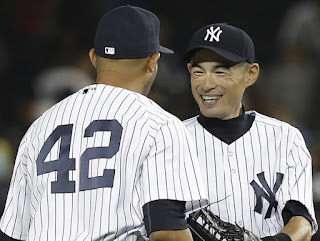
Ichiro and that 100% man...
AND so the race was on...soon to become more akin to a festering death watch. He was still spunky at 38, he still had most of his speed, but age was unraveling his springy singles swing. 2011 brought an end to his 200-hit skein; things got hinky enough in Seattle the next year that the M's management realized they couldn't subsidize his drive for 3000 hits any more: they shipped him to the Yankees, where he could be a media toy.

He hit .322 down the stretch in 2012, which prompted the Yankees to re-sign him, but disaster ensued as the Bombers choked themselves with ancient superstars for two cataclysmically creaky seasons, barely scraping over .500 in both 2013 and 2014. They decided that keeping Ichiro around in order to milk his 3000th hit was going to kill the cow; thus Suzuki was sent to where so many aging New Yorkers had always gone--Miami. 
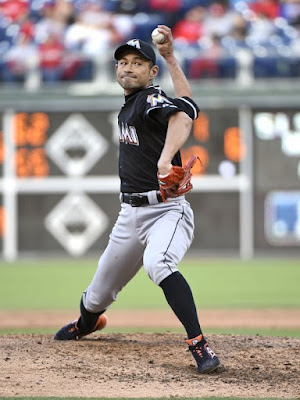
Is there anything this man can't do? 
The Fish knew it was going to take two years to get Ichiro over the hump, but 2015 was a nightmare: Suzuki hit just .229, looking especially helpless in September (10-for-72, ,139). They swallowed hard, but kept the faith--and Ichiro responded with a carefully curated comeback season in 2016, riding a hot start to a .291 batting average--including a month-long stretch in May & June where he rekindled a vivid facsimile of his previous panache (32-for-83, .386). He recorded his 3000th hit on August 7th (sadly, in Coors Field, not in Miami).

There would be another 89 hits, all semi-superfluous--in 2017 he and the Fish would partner to give him another record to go with his single-season hits mark: Miami sent Suzuki up as a pinch-hitter 109 times, shattering the old single-season record held by Rusty Staub. The next year, serendipity in the form of injuries gave Ichiro a chance to briefly reconcile with the Mariners, and in 2019 MLB's internationalist impetus gave him a chance to return to Japan with the M's and take his final bow (the PR was better than the result: Suzuki went 0-for-5 in his swan song).

WHAT's clear about Ichiro is that as good as he was, he became an even bigger media star throughout this process. Getting to 3000 hits clearly ensured his enshrinement (only three of the 33 players to do so have so far evaded Cooperstown; one of those--Miguel Cabrera--will join the other thirty in 2030). 

But it's that unanimity thing that we were decrying above. And now a chart of those thirty-three 3000-hit guys is needed, to help us as we navigate a thicket of motives (and a nest of vipers).

As you can see, it's the same list twice--first sorted by the neo-sabe all-purpose dandruff shampoo: Wins Above Replacement. (Note, though, we use only the offensive portion of the method here, for two reasons: 1) we have innate & complete distrust of the defensive portion of this stat; 2) we are only discussing hitting here).

The first time (left side)we show the counting stat version--oWAR summed up and sorted in descending order. Do kindly note who is at the bottom of that chart.

The second time (right side) we show it as it should be seen--as a rate stat (oW/g means "oWAR per 162 games"). It's a more revealing measure, but putting them side-by-side produces its own revelations.

NOTE who is at the bottom of the list in both instances...

That's right. Those same folk who are so incensed at the lack of unanimity for Ichiro are generally skeptical about Lou Brock's bonafides to be in the Hall of Fame whatsoever.

(Of course--to steal a phrase from Nate Silver--there is more to Ichiro than this. But it's the hits thing--that shiny round number--which has sealed the deal and poured gasoline on a long-smoldering urge for unanimity. We'll explore some of the "more" further below.

All that said, it's clear that something amiss is afoot in the little world of baseball media. It began with overmoralizing and the boycott of steroids users for Hall of Fame induction, a stance which has festered in many ways and become egregiously tiresome. (So much so that we can read Joe the Poser whining about having to watch Alex Rodriguez and Manny Ramirez become the latest victims of this ongoing pox against reason. Don't kvetch, Pose-man-ski--call it out for the sham that it is. But that will never be the approach taken by someone so expert at talking out of both sides of his mouth...)

Even Silver--that puckish pundit who was teleported into politics by a stroke of good fortune and now purportedly funneled and funded by the likes of those working hard to destroy what's left of democracy-- decided to weigh in on the Ichiro/Hall of Fame matter. (He was careful not to tip his hand regarding unanimity, however--he's learned over the year that speaking with a forked tongue pays better). What he did do is create a silly pseudo-system for measuring "greatness" that is one part math, one part Antonin Scalia, one part Chat GPT, and one set of spare parts cribbed together from the "C" and "D" positions in a "Four Square" court. 

His comment on Ichiro was mostly limited to "of course"--but he worked hard at distorting his system to comically maximize Suzuki's score, hedging his bets further by suggesting that we should include his Japanese League stats in our assessment. (The one good thing in Nate's noodlings was some actual pushback on the steroids ban, where he rightly suggested that such things should not be unilateral, and expressing mild dismay that his fellow neo-sabe media mavens were perpetuating it.)

Suzuki's "international record" of 4367 hits has been bandied about as another argument for unanimity. Ironically, Silver's attempt to transcend WAR in his analysis foundered here, as he tried to parse Ichiro's early years using that measure without verifying how he was adjusting the stats to do so. 

SO that's what we'll do right now (and then take things in an unexpected direction). Ichiro's best case for "unanimity" comes from combining those Japanese League stats with his peak years in MLB (2001-10). Can that pass muster? 

To do that, we must adjust his years in Japan so that they reflect as realistically as possible what adjustments he made when playing in America. We'll cut to the chase with the numbers and explain on the other side of the chart:


At the top we have his 2001-10 stats, then his actual numbers in Japan. The third line sums these as if these were achieved in MLB--the "idealized" portrait of Ichiro's career. (We'll let those adepts in the semi-arcane art of "similarity scores" find the players who most resemble that fictional statistical line--but we'll clue you in that such a match will be hard to find: Suzuki's elevated HR total in Japan makes this idealized version a bonafide anomaly.)

Via some formula tinkering, we halved Ichiro's JL homer total to reflect how he approached hitting in MLB. We added triples, reduced doubles, and pushed his slash lines down a bit more than 10%. The adjustment gives him a slightly lower BA but a bit more power (possibly befitting what would've been the case in the higher offense 1990s).

The best fit for the adjusted numbers in terms of a similar performer is actually an amalgam: Rod Carew for batting average, Lou Brock for the shape and quantity of extra base hits. This "idealized Ichiro" will gain some in oWAR and oW/162, moving in the direction of Carew and leaving Brock behind. (But that doesn't boost him into anything remotely resembling unanimity: the region between Carew and Brock in HOF voting history ranges from 80%-Brock--to 91%--Carew. Both went in on the first ballot.)

And then there are those later years, when Suzuki pushed toward "3,000 American." In a different time, in one less fraught with division, strife, and pent-up grievance needing some semi-adolescent form of relief, those last years would have likely taken most of the wind of the "unanimity sailboat." (Pose-man-ski addresses the inverse of this notion in his both-side-windering, misleadingly "objective" assessment of what he should have called the "anti-unanimity knights," who--rightly--hold that due to the long-term flaws of the Hall of Fame election system, some checks and balances should apply even to slam-dunk candidates.)

But this breed of BBWAA voter needs something else. They not only need to believe that they are so much smarter than those who came before them--smarter than so many of the old guard pilloried by them when they were the brash outsiders--that they (just as the "analytics" folks who followed in their wake) have pushed much too hard in the other direction, creating the "groupthink" that is astonishing and troubling to someone like Stark (even as he finds himself embracing it).

How do these now-established voters proceed? They know that they are, at least in some ways, culpable for the transmogrification of baseball into the distended shape that it now encompasses, and while they can't bring themselves to jettison their ardent (and often unholy) love for "The Three True Outcomes," they know that the game has become significantly diminished by its increasingly two-dimensional uniformity.

So, as a form of semi-pathetic expiation, and in parallel with a nation buffeted by division and craving something (anything) resembling unanimity--they seized upon Ichiro as a symbolic token of such. Even better with respect to their (not-so) latent guilt about their role in turning the game into a home-run derby version of 1968, Ichiro is a throwback to the anti-sabermetric approach to baseball that they've discovered that they miss but don't have a clue as how to resurrect. 

Thus they look for their expiation by bandwagoning him into a unanimous vote. The seed was planted when the membership actually achieved such a vote with Mariano Rivera--undeniably the greatest relief pitcher in baseball history. 

Hence the need to prop up Ichiro's case sabermetrically, as has been done in various ways ahead of the just-completed vote. The mild negatives we've covered above about Suzuki's MLB career simply did not appear in print during the run-up to the 2025 election...

This is more than groupthink (the euphemism employed by Stark and Joe the P). This is the nudge-nudge/wink-wink dynamic of a cadre of folks who banded together and, ironically enough, in some very strange (but predictable) ways, have turned into the people that they hated so many years ago.

As also seems to be the case in much larger, darker matters, within entire segments of America.

If this is not exactly fascism, it's an embryonic form of it, built from anger, exhaustion, grievance and lingering guilt. And it's manifesting here, as elsewhere, from folks who now have skin in the game and want to control the vertical and the horizontal (and probably the diagonal as well). Being eighty to ninety-one percent right is no longer satisfying to them: they crave unanimity. (The call-outs regarding the lone Ichiro holdout that have surfaced in the wake of the voting results have gone beyond annoyance and contempt; they've become much more combative.)

NOW for something of an unexpected direction. In modern baseball (let's call it since the flurry of expansion in the early and late 1960s) there have never been enough high-BA players. They were on the wane before BA was "exposed" as a wrong-headed approach to the game. With the exception of the offensive explosion, which raised the overall average of offense vis-a-vis isolated power much more than it did batting average, such hitters have been exceptionally scarce. Even fewer have done it year in and year out: they can counted literally on one hand--Carew, Boggs, Gwynn. (Luis Arraez is a pale throwback to those guys; Ichiro fits in somewhere in between that due to a greater variability in maintaining a high BA and his late start in MLB.)

Opinions differ as to whether Ichiro went for 3000 for his legacy or because he'd studied the history of the game and concluded that his own personal "politics of glory" demanded it. His degraded performance level over his last years is something that would have been mercilessly harped upon in other, lesser players. His style of hitting may have prevented a good bit of this, however--and once he retired, there was a greater level of nostalgia for it due to the "launch angle" explosion.

It should be noted, though, that some such players manage to defy the odds of aging. Take a look at the difference in late-career performance between Suzuki and Gwynn:


Gwynn's data is highlighted in yellow. Note the similar slash lines for the early-mid parts of each career; Ichiro actually has more HR power than Tony. (But note also that Tony still has a somewhat higher OPS+ value in this comparison.)

But things change dramatically when the eras shift. One might initially conclude that the uptick in offense (and maybe a juiced ball, eh?) just carried Gwynn along to better numbers, but look again. Look at those OPS+ values for the late-career data: Tony gains ground relative to the league, while Ichiro pretty much collapses. 

It's possible that Gwynn's strong finish helped to elevate his vote total when he arrived on the HOF ballot in 2007--he received 98% of the vote. With data like this, it's a real stretch to conclude that Ichiro is a better candidate--but that's what the current BBWAA cabal has done. No one railed about the injustice of Gwynn not being inducted unanimously back then. (Nor did anyone get tweaked about Cal Ripken, who came even closer than Tony--99%--in the same year.)

Ichiro almost certainly doesn't care at all about his vote percentage. Even the people grousing about it say it doesn't matter (even though they are grousing about it). What they need to do is take their thumb off the scale, to dial back the groupthink and put this into perspective. But this episode (and their increasingly urgent push for Andruw Jones--we'll spare you a recap of that...) shows that they are simply incapable of doing so. 

Steve Buckley at The Athletic does a clever feint around the "reveal yourself" demands that have been surfacing. He reminds us that there should be room for more "informal" votes, less freighted by the need for an ascendant faction of the voter population to flex its muscles. There are tribute votes for players who have no realistic chance to be inducted. There are various attempts--some valid, some misguided (paging Jay Jaffe...)--to "influence" vote for players who would fall off the ballot. (In Jaffe's case, there are mixed motives: he was pushing Phangraf's "pitch framing" and making a dubious attempt to "innovate." His ploy failed.)

Buckley had it right--the tribute vote is something that transcends all of this scurrilous skullduggery, arm-twisting, bandwagoning, nocturnal-emission proselytizing. It seems to be an endangered species in this little world's embrace of "designer fascism." The man who would be folksier-than-thou, Joe the P, who loves to digress into such tribute territory at the drop of a hat (or the sacrifice of a pawn on his chessboard...), whiffed in a major-league way in 2025...after waxing folksy-eloquent about a popular favorite in sabe-ish circles, playing (of course) the hometown chauvinist card--the man in question was part of the Royals' slightly improbable World Series win in 2015--and reminding us that the same fella in the very next year then helped a team win its first Fall Classic in more than a century. 

This player also pioneered the "post-postmodern" appearance of the "star utility" player, bursting onto the scene with a fabulous, MVP-adjacent season in 2009. He had a heck of a career over thirteen seasons: he even compiled a quite respectable WAR total! 

Of course, it wasn't enough to get him into a "bandwagon" mode, or probably even a Jaffe-goes-tilt-at-windmills thang, but we can guarantee you that Ben Zobrist would have really appreciated receiving a few stray votes. And if anyone was perfectly set up to deliver one to him, it was Joe the P.

Who whiffed on it. And now, forevermore, ol' Joe will have to live with the fact that it wouldn't have mattered one whit if he'd left off a check mark alongside Ichiro's name, but it would have meant the world to Zobi won-Zenobi to have received at least one Hall of Fame vote. But Joe (and the rest of what that nasty old Tom Pynchon once called "the whole sick crew"...) just up and left Ben by the side of the road...

CONGRATS to Ichiro, C.C. Sabathia, and especially to Billy the Kid--who wasn't too proud to cry when he got the news. And remember--dissent is a good thing.

Wednesday, December 25, 2024

IN A WORLD OF DOUBLING DOWN, WE TRIPLE UP...

ON Xmas Day in a time of incipient woe, we look for the miracle massé shot on the pool table of life, the distraction setting aside all the infractions against humanity that are on their way via anti-Santa's sulfurous sleigh.

And whenever things are that way, you know which way we're gonna go with it--we're going to go with the impossible wish-fulfillment hidden within our careening "National Pastime" that animates the vestiges of our long-ago sugar plum visions. We look to the game's deep past, we celebrate its youthful anarchy and its freedom from the elephantine torpor of the long ball and the blights upon its soul that have come to cripple it. 

To cut to the chase: we go back to triples--that eternally endangered "long hit" that once gave the game its perfect seam of speed and power, but now is a quaint afterthought, with a record season-performance that's more out of reach than DiMag's 56-game streak. It's a mighty mark held by an anomalous non-entity: the game (and life itself) needs more of that, needs more connection between its gods and its ordinary people so that the scales of life can be more equitably (and humanely) balanced. 

Yes, yes: pass the pipe dream and let me smoke it. But take a long puff on it while we revisit the extraordinary ordinary folk who were able to hit a basketful of triples when the fruit was still on the trees, and ripeness had not turned into rot. Perhaps there is still time to follow Mark Twain's advice and "dream better dreams"...

SO on the with the show-and-tell already--we're gathering up all the player-seasons where at least fifteen  (15) triples are displayed in the batter's hitting line. 

And there's no better way to show than in our patented TimeGrid™ chart (at right). Proving again that even a sad tale can be strangely exhilarating when told well..

Thus you now know that there are 552 instances where players have hit 15 or more triples in a season. And if you have a lightning-like, abacus-configured mind, you've already discerned that 505 of those player-seasons occurred between 1882 (the first year where 15+ triples were hit) and 1949. (That's an average of about seven-and-a-half such seasons per year.)

And you also know that only 47 such instances have occurred since 1950. (The curse of depraved deprivation, indeed: that works out to less than seven-tenths of an instance per year...)

OF course, when you look at the specific pattern in the data, you can figure out what happened. Both the style of play and the shape of the new ballparks that began to arrive in the 50s and 60s shifted things in ways that continue to plague the game, shifting its priorities ahead of the Sargasso Sea of neo-sabermetrics and its "velocity/launch angle" Armageddon (all puns most definitely intended).

But let's celebrate those "men of yore" who hit all those triples back in the day when ballparks were still attuned to the game's pastoral proclivities (now in approximately their ninetieth year on life support). 

A few of these men are in the Hall of Fame--can you name them all? It's probably not surprising to discover that those with the most 15+ triples seasons overall (Roger Connor, Dan Brouthers, Joe Kelley, Jake Beckley, Ed Delahanty) are amongst the enshrinees. Abundant triples were but one part of their accomplishments.

But we also see an abundance of folks--some exalted, some more ordinary--who had a knack for the nineteenth-century game's version of the "long hit" (and, in a few instances, not much of a knack for anything else). We're thinking of folks like Bill Kuehne and Frank Fennelly, players who'll never be given even a first thought as a Hall of Famer but who were able to partake of what the game was making possible in its anarchic infancy. 

Buck Ewing is the only catcher to have four 15+ triple seasons, and while it's not the main reason he's in the HOF, it's a fitting footnote. And such a note might give a nudge to the (apparently non-existent) "nineteenth-century veterans' committee" to put Ed McKean into the Hall where he belongs (but not before Pete Browning and Bob Caruthers!)

Yes, great players and great names (Oyster Burns!)--of course, "Big Sam" Thompson and "Wee Willie" Keeler are already in the Hall--they have eye-popping numbers that are now waved away by the isolated power fetishists known as neo-sabes. Bid McPhee also made it, the only nineteenth-century player to be inducted in the twenty-first century: it's time to rectify that.

BUT let's shift forward, into the "depraved deprivation" period (as if we could escape it...). There are 36 players since 1950 who've managed to hit 15+ triples in a season--how many can you name off the top of your head (or even on the top of your head, for that matter)?!

Aw c'mon, we're talking just three dozen guys...hmm, radio silence has never been so, well, silent...

Possibly you can think of some really speedy guys who might have done it more than once--as in 47 instances, 36 players? Would it help if we told you that two of them have names with repeating initials? No? OK, what if we give you the damn initials--CC and WW? (No, not C.C. Sabathia!!)

So that's Carl Crawford (three years in a row from 2004-06) and Bill James' old fave Willie Wilson (four times--1980, 1982, 1985, 1987). But there's one more guy with four who matches Wilson--is there a ray of hope that someone out there will pick up on that shameless clue we just gave you?

Right--it's Jose Reyes (2005, 2006, 2008, 2011), with that last one being one of three that occurred in the same year--gasp! As the chart above shows, it's the first time that this had happened since 1984, when the fearsome foursome of Dave Collins, Lloyd Moseby, Juan Samuel and Ryne Sandberg did in the same season. (Roll over, George Orwell...)

Samuel is one of three players who managed to "repeat the feat", doing it again in 1987. The other two are a "strange bedfellows" duo from the seventies: Garry Templeton (1977, 1979) and Jim Rice (1977, 1978). Templeton and Rice, along with Rod Carew, made up a troika of triples gods in 1977; Templeton, along with George Brett (20 triples!) and Paul Molitor, were a trio in 1979. (In 1977, it had been thirty-three years since there'd been at least three hitters with 15+ triples in the same year--in that war year of 1944, there were five who did so: Johnny Barrett (19), Bob Elliott (16), Johnny Lindell (16), Snuffy Stirnweiss (16) and Phil Cavarretta (15).

That 20+ triples thang does tend to capture people's attention: Jimmy Rollins' 20 three-baggers in 2007 might have been a part of why he was named MVP that year. (It didn't do the trick for Curtis Granderson, who hit 23 the same year, the most since Dale Mitchell in 1949. Not sure what got into Mitchell that year: he hit 23 more triples over the final seven years of his career.) The other players since 1950 to hit 20+ triples in a season--in addition to Brett, Rollins, and Granderson--are: Willie Mays (20, 1957), Willie Wilson (21, 1985), Lance Johnson (21, 1996) and Cristian Guzman (20, 2000).

How about the unlikeliest fellas to hit 15+ triples? We can take a crude measure of that by looking at the stolen base totals for all of those on the list. Two guys stand out, having each stolen only two bases in their 15+ triples seasons: Pete Runnels (1954) and Gino Cimoli (1962). Aside from our own decade, the 60s are the lowest of all for 15+ triple seasons: in addition to Cimoli, the only other player to do so is Johnny Callison (1965). 

AND "depraved deprivation" has reached its zenith (or its nadir, depending on your perspective) in our own time. The lowest twelve-year run in MLB history for 15+ triple seasons is in place right here, right now. From 2013 to 2024, there has only been one such season turned in--a malevolent monument to the version of baseball brought to us by the architects of analytics. 

Any guesses as to who that mystery man is? Here's a clue (yes, characteristically oblique!): he had the same number of walks (15) as triples (15) that year. A year, in fact, that matches that matched number of triples and walks...

So that's 15 triples and 15 walks in '15. Given the nature of how things changed in the years after that rookie season, he hit only seven triples over the next four years, while hitting 93 HRs in those seasons (2016-19). In 2021 he was a hero in the NLCS, hitting three homers (and, yes, a triple, too). In 2024, a return to the team he helped win an unexpected World Series in '21 didn't prevent him from having what looks to be a catastrophic, career-ending campaign...

As Syd Barrett said to his befuddled Pink Floyd bandmates: have you got it yet? 

Let's surely hope that Eddie Rosario is not the last man in the history of MLB to hit 15+ triples in a season. No offense to him, really, but that would be a blight on the game if it were to be so. (We might just have to force him into indentured servitude as one of anti-Santa's elves.)

Final irony, and it'll remain intact if no one gives Eddie the Elf any more MLB playing time: he hit more triples in 2015 than he did over the rest of his career (nine more seasons!). 

BUT there's hope on the horizon: in 2024, two players--Corbin Carroll and Jerran Duran--each hit 14 triples to lead their respective leagues. 

Remember, it's always darkest before the dawn. With tenacity and luck, we might yet escape our doubled-down world and triple up. Let's dislodge those who were born on third and make triples safe for the world again...3-ball in the corner pocket!!

Wednesday, December 11, 2024

OF DICK AND DEV: AN ANTI-CLIMACTIC SENSE OF AN ENDING

LET us begin with two endings: the final steps of a Kafkaesque journey to posthumous redemption, and the sudden, all-too-anonymous conclusion of a brilliant but sadly squandered life. Much treachery and tragedy intervened in the events leading to these sobering anti-climaxes, some (if not most) of it self-inflicted: but these two men--the "notorious" Dick Allen and the "flamboyant" Brock Hanke--spent too many years of their lives diminished by a particularly virulent form of insiderism that continues to plague the world of baseball. 

Thus shall it ever be so. Here we write often about the opening up of vistas that few if any (want to) see, perspectives that began half a century ago when a cynical-yet-idealistic seventeen-year-old went to college and bonded with a draft-dodging denizen of the hippie demimonde with prodigious and protean skills who reeked of endlessly provocative opinions. 

That was Hanke (pronounced "hank-y"), who anointed me into his loopy world when I professed affection and support for an embattled slugger who didn't want to be called "Richie." 

DURING the balance of the 1970s, our allegiance to a pre-Bill James "sabermetric" approach to baseball deepened, eventually leading us into a variable association with Bill's 1980s efforts to create a blanketed play-by-play capability (Project Scoresheet). It would also lead to Hanke's (temporary) anointment as the successor to Bill's Baseball Abstract (until Bill pulled the rug out from under him).

All through that period, as we developed our own mythical world (assorted tales of the San Antonio Trotters, a form of "sabermetric wish fulfillment" blown up from our days of wrangling in intramural softball), one axis of our foundational beliefs was in the conjoined greatness and martyrdom of Dick Allen, whose career took a series of dramatic and confounding turns until it came to a sudden, anti-climactic end in 1977. (As we rewrote the landscape of baseball via the Trotters in those days, we naturally found a way to include Dick on that team, which had progressed from rag-tag to dynastic in the intervening years: as a prestige platoon player, "Big Dick"--as Hanke liked to call him--upped his lifetime HR total much closer to 400 before "officially" retiring at the end of the decade.)

The liaison with Bill James started then (it was actually yours truly who discovered him first, being one of a few hundred who purchased his self-published 1978 edition), but it was Hanke and his applied math background that confirmed the essential efficacy of Bill's early work, which led to our years of producing baseball annuals in the 1990s, which were subverted by what has now become more of a plague on the game than a means to its transformation. The true scandal of "sabermetrics" is how it has undermined baseball even as it purports to anatomize it, and how it became an instrument of an ever-more invidious form of insiderism.

SUCH behavior was first exposed by Bill James in his cynical, overblown Politics of Glory, which unceremoniously combined new numerical formulations with callous muckracking, skewering baseball's Hall of Fame in ways both rightful and reprehensible. In an age (mid-1990s) when new statistical measures (OPS, OPS+) were opening eyes to the hidden accomplishments of hitters long shunned by Cooperstown, James took out a contract on Dick Allen and shot him down with a series of pronouncements that deserved a libel suit. 

Even though some of James' long-time allies/colleagues took up against him, the damage done to Allen's chances for statistical reconsideration (and enshrinement in the Hall of Fame) was epochal.

James' behavior became the template for a new flavor of "sabermetrics" which would fire hot for a decade until generational change permitted the "outsiders" to become "insiders." (James himself helped spawn this movement when he took a job with the Boston Red Sox, being the first of many to make the world safe for sabermetrics, but not necessarily vice-versa.)

Prior to that, Bill's second edition of his Historical Baseball Abstract (2001) employed his Win Shares method (moving "beyond" the Wins Above Replacement method he'd created in the 1980s, a tool that Hanke inserted into his 1989 Baseball Abstract, unwittingly setting in motion a process that would turn the measure into a lightning rod for insiderist "culture wars" that continue to persist). The results of the Win Shares method produced some inconvenient truths--one of which was that, according to James' own measures, Dick Allen (even with his relatively short, injury-riddled career) had cleared the bar for induction into the Hall of Fame.

James' response to this was to hint that Allen's "psychological problems" had caused him to squander a level of talent equal to that of the game's greatest players (oddly, limited to other African-Americans such as Willie Mays, Hank Aaron and Frank Robinson), which apparently constituted grounds for ongoing skepticism about his suitability for Cooperstown. When pressed further, James noted that Allen's eventual admission was "inevitable" and that he'd simply look the other way regarding whatever the "insiders" did. 

Meanwhile, the Wins Above Replacement method managed to target Dick as well: its distorted defensive calculations produced a penalty that was virtually unique, dropping his "overall" score into a range where ruby-throated "sabermetric" chirpers could make unctuous ululations reiterating his "marginal" status for induction. 

All of this kept in play a lingering uncertainty that prevented the "new numbers" (per Jayson Stark, in a rare disingenuous moment) from crashing through to give "Crash" (Allen's nickname, given to him due to the sound of what happened when his 42-ounce bat met the baseball) the needed cred to make it through baseball's ultimate insider kluge, the umpteen-times-shuffled-off-to-Buffalo "Veterans Committee."

Dick became philosophical about his ongoing banishment, beginning with his autobiography (appropriately enough, entitled Crash!)--over the years, he did what he could to mend fences, knowing that whatever outcome would ensue was out of his hands. He was gracious, grateful and moving when the Baseball Reliquary inducted him into its Shrine of the Eternals (who, a few years later, would create one of their typical "strange bedfellows" situations by inducting Bill James!)

Meanwhile, in response to the media shift and his own incipient health issues, Brock Hanke absented himself from the "real world" cauldron of baseball opinion, opting for an association with the Hall of Merit, a cadre of individualist systematizers who devised their own (and more convenient) rules of induction for an alternate baseball Hall of Fame. At my request, he made a half-hearted attempt to get that intriguing group to run a parallel experiment using the more draconian inductions standards imposed on the brick-and-mortar Hall of Fame (75% of the total vote). In two words: they declined.

AND likely you know the rest of Dick's story: missing induction via that ever-shifting committee in 2015 by one vote, then succumbing to cancer in December 2020 as another incarnation of insiders decided not to vote because COVID made it "too cumbersome" to operate in true insider fashion. And then, another stinging one-vote miss in 2021.

In 2022, Brock Hanke received some sobering news about his physical condition: he'd developed a weakness in his pulmonary system that would become more pronounced over time. Work he had done to address the problems in the Wins Above Replacement method--a project he'd fretted over for years--was again shelved without seeing the light of day. (This had been a lingering pattern for him over time as the escalating signals of his ultimate health issue affected his ability to physically function, an occurrence that seemed to make him gun-shy with respect to the increasingly "inside" world of advanced baseball statistics.) My attempts to engage him on such matters and to advocate that he make his findings public were not successful.

With a caretaker living with him in his suburban St. Louis home, he still sounded reasonably alert in February of 2024--the last time we were to speak. His stamina was clearly reduced: he begged off the call shortly after being reminded about my homage to his fictional self's Hall of Fame-level career that I'd reconstructed from our long-ago forays into what is now called "fan fiction." (Perhaps unsurprisingly, those texts had turned into another critique of Wins Above Replacement.) All in all, however, there was little indication of any imminent change in his condition.

Becoming involved in my efforts to wrap up that long-running French film noir project (occasionally referenced here), my opportunity to reach out to him was curtailed, and the summer passed into fall. After returning from the first of two "final finale" screening series in San Francisco in mid-October, it seemed to be a good time to reestablish contact. An email went unreturned (not an especially concerning event: Hanke was a notoriously poor correspondent). But then the attempts at reaching him by phone produced the troubling fact that his long-time land line at his home had been disconnected.

An initial search of the Internet did not produce an obituary, but a more specified query revealed that Brock Hanke (known to me always as "Dev"--his 1970s nickname) passed away on the thirty-first of May. A subsequent search produced a sound file from a sports radio show from just two days before his death where he'd made an appearance, where he definitely sounded diminished. (Few people were as verbally articulate as he was, and here he sounded--to use an "analog analogy"--like a 45rpm record being played at 33.)  And yet it's clear from the audio transcript that during his on-air chat time, Dev had little or no sense that he was about to pass away...


SO both men--Richard Anthony Allen and Brock Jay Hanke--did not survive long enough to see "Big Dick" finally crash through into the bubble-world of the hallowed. We put aside our lingering sense that perhaps the blemish of Allen's unjust absence from the Hall might still be an appropriate symbol for the hollowness at the center of its "hallowed halls," and we celebrate for his family, his friends, for those who resolutely championed him for so long, and for that long arc of justice (to reframe the words of Martin Luther King, Jr.) that finally bent toward mercy, forgiveness, vindication--and redemption. 

And yet it is a bittersweet, anti-climactic ending for both men--and for countless others like Hanke, who'd advocated and hoped and prayed for some form of intervention that would have brought the events of Sunday, December 8th, 2024 to us so much sooner, when so many more folks could share in the moment, when its potential for a form of healing bliss was so much more palpable. 

Many will remember Dick Allen, and that is all to the good. But few if any will remember Brock Hanke, and while some of that is on him, it is sobering to contemplate how so much talent can have so little tangible to show for it. Let's hope that wherever his essence might be at this moment, he is finding enjoyment in Allen's belated vindication. Farewell, my friend!

Monday, November 4, 2024

YANKEE POST-MORTEM: BIG INNINGS IN THE WORLD SERIES

THAT Game Five really was a strange game, indeed...the Yankees did a bizarre volte-face after looking as though they were serious about getting back to LA.

The Dodgers' surreal five-run rally got us thinking...how many 5+-run innings have occurred in the Worls Series. To answer that question, we dug into Forman et soeur's online data resources...

Here's the TimeGrid™ chart for that (at right):

IN all the craziness of that Dodger fifth inning, we might easily forget that the Yankees also had a five-run inning (the night before in Game Four--in the eighth inning to break that game open). 

All in all, we 've had 105 5+-run innings in World Series history. which have occurred in 69 of the 120 World Series that have taken place since 1903.

Now for some of the details in the chart, working backwards in time:

In 2023, the Texas Rangers had two 5+-innings in the same game en route to winning the World Series.

In 1993, the Phillies and Blue Jays had 5+ run innings in the same game (Game 4, a 15-14 slugfest won by Toronto). The Phils actually had three such innings in that Series, but still managed to lose.

In 1987 the Twins had two and the Cards had one, but none in the same game--Minnesota won the Series in the first instance of the home team winning all of the games played.

In 1979, the Orioles had three such innings and the Pirates none, but the O's still lost the series in seven games.

In 1975, the Red Sox did it twice while the Big Red Machine had no such big inning, but the Reds still won the Series.

In 1968, the Tigers only did it once...but it was a ten-run inning, tying the record most runs in a World Series inning (make your guesses now as to the identity of the team that did it first).

In 1961, the Yankees had two such innings in the same game en route to a 13-5 win (and a Series win) over the Reds.

In 1960, the Yankees had three such innings, in the three games where they routed the Pirates (Games 2, 3, 6), but the Pirates had one of their own in G7 and won the game and the Series on Maz's homer.

In 1956, the Yankees and the Dodgers had such innings in the same game (Game 2, won by the Yanks, 13-8; Game 5 was Larsen's perfect game).

In 1952, the Yankees had two such innings, but they actually lost one of the games in which they did it (though they did win the Series).

In 1942, the Cardinals and the Yankees had 5-run innings in the same game; it was won by the Cards 9-6 en route to a surprising Series win over the Bombers in five games.

In 1936, the Yankees had three such innings against the Giants, two of them in a game where they set the record for the most runs scored in a World Series game (18). They won the Series in six games.

In 1929, the Cubs and the A's had 5+ run innings in the same game (Game 4); the Cubs got five in the sixth to take an 8-0 lead, but the A's scored ten (10!) in the seventh in the biggest World Series comeback ever.

In 1923, the Yankees had two such innings and finally won their first World Series against the Giants (after having lost to them in 1921 and 1922).

In 1912, the Giants had two such innings (Games 6 and 7), but there was a tie game in the Series that year and they lost Game 8 to the Red Sox (who won their first title...there would be three more that decade before the Curse of the Bambino would set in).

In 1908, the Cubs had two such innings, beating the Tigers for the second straight time in the Series (Detroit would lose again in 1909, becoming the only team to lose three World Series in a row).

One last fact: World Series teams who've scored 5+ runs in an inning almost always win (no big surprise there!), but there have been seven losing teams who've done so in the Series: the Cubs in '29, the Yankees in 1942, 1953, and 1956, the Mets in 2000...

--And the Phillies in 1993, who managed to lose two games in the same series (!!) in which they scored 5+ runs in an inning

So the '24 Yanks are, after all is said and done, just a slightly anomalous underachiever. As was the 2024 World Series itself--looking as though it might be more interesting, then turning into mush with the two MVPs unable to replicate (via slump and injury) their regular-season dominance. So it goes...

Monday, October 28, 2024

WORLD SERIES: QUANTIFYING THE YANKEES' UPHILL BATTLE

The Dodgers' makeshift "Big Two" (Jack Flaherty and Yoshinobu Yamamoto) did well enough in tandem...and bolstered by continuing home run heroics, those Boys in Blue leave Dodger Stadium up 2-0 as the 2024 World Series--the first pitting baseball's two most storied franchises since 1981--moves to the Bronx tonight.

And that puts the Yankees into a sizable hole. The question that needs asking/answering is: just how sizable is it, and what does past history tell us about teams that go 0-2 on the road at the outset of the Fall Classic? (That's outset, not onset--though the onset of gopheritis certainly put a pox on the left arms of Nestor Cortes and Carlos Rodon...)

AS always, we go pig-for-truffle to bring you the whole data--the tree and the roots, the leaves, the bark, even the woof and warp if you don't rein us in. And as always, we'll flip the script and invert our presentation by showing what happens from the perspective of those home teams who barrel out of the gate at 2-0 in hopes of riding the rail all the way to the finish line. 

This takes us all the way back to 1907, when the Chicago Cubs first throttled their opponents twice at home (those luckless Detroit Tigers, still the only team in baseball history to lose three World Series in a row). 

As you'll see, it took the fifteenth time this this happened for a team that went 0-2 on the road to start a World Series (the 1955 Brooklyn Dodgers) to actually prevail at the end. Oddly, that occurrence set off a little chain of counterintuitive repetitions: four more consecutive instances of defying the norm (1956 to 1971), followed by a series of stutter-steps into the mid-80s, before finally settling back into a "groove of orthodoxy" in 1987 in which we are still enmeshed.

THAT's sixteen straight times where the team going 2-0 at home goes on to win the Series, with the majority of them (11) resulting in sweeps (aka "the big 4-0") or a five-game romp (4-1).

All in all, teams that take advantage of the home field advantage in the World Series wind up winning those series in more than 80% of the cases.

AND that is what the Yankees find themselves up against as they take the field tonight, with Aaron Judge still reeling in the kryptonite of the post-season, and the unheralded Clarke Schmidt taking the mound for a team that needs Judge (and the bottom part of its batting order) to show something resembling a pulse before it's time for the body bag.

Of course, the Dodgers have blown 2-0 home advantages before (think 1956 and 1978), but they pulled their own Houdini act in this regard in 1981, the last time these teams met. If the Yankees could somehow get things in gear to do so in 2024, that would make three consecutive times that the teams have traded such counterintuitive outcomes between themselves--a record that Jayson Stark (aka baseball's "Mr. Unique) would clasp to his bosom with devilish glee.

A World Series with real drama is what we want, of course--because obviously we are starved for it in real life. (Insert your favorite rude noise here.) But seriously, a seventh game is the only type of Armageddon that we can sit back and enjoy, and we really need that given the specter of doom that has encircled the land of the free (for now...) and the home of the formerly brave (looking at you, Jeff "Bozo" Bezos) at this late date in latter-day tomfoolery. 

SO...root for that seventh game already. It may be all we get in this uniquely felonious fall...